Union Budget 2026 Highlights | Key Announcements
Union Budget 2026 highlights key announcements on taxes, railways, MSMEs, agriculture, jobs, infrastructure, healthcare, & education



San Francisco
Union Budget 2026 highlights key announcements on taxes, railways, MSMEs, agriculture, jobs, infrastructure, healthcare, & education

Here are the highlights of the Union Budget 2026-27 presented by Nirmala Sitharaman.
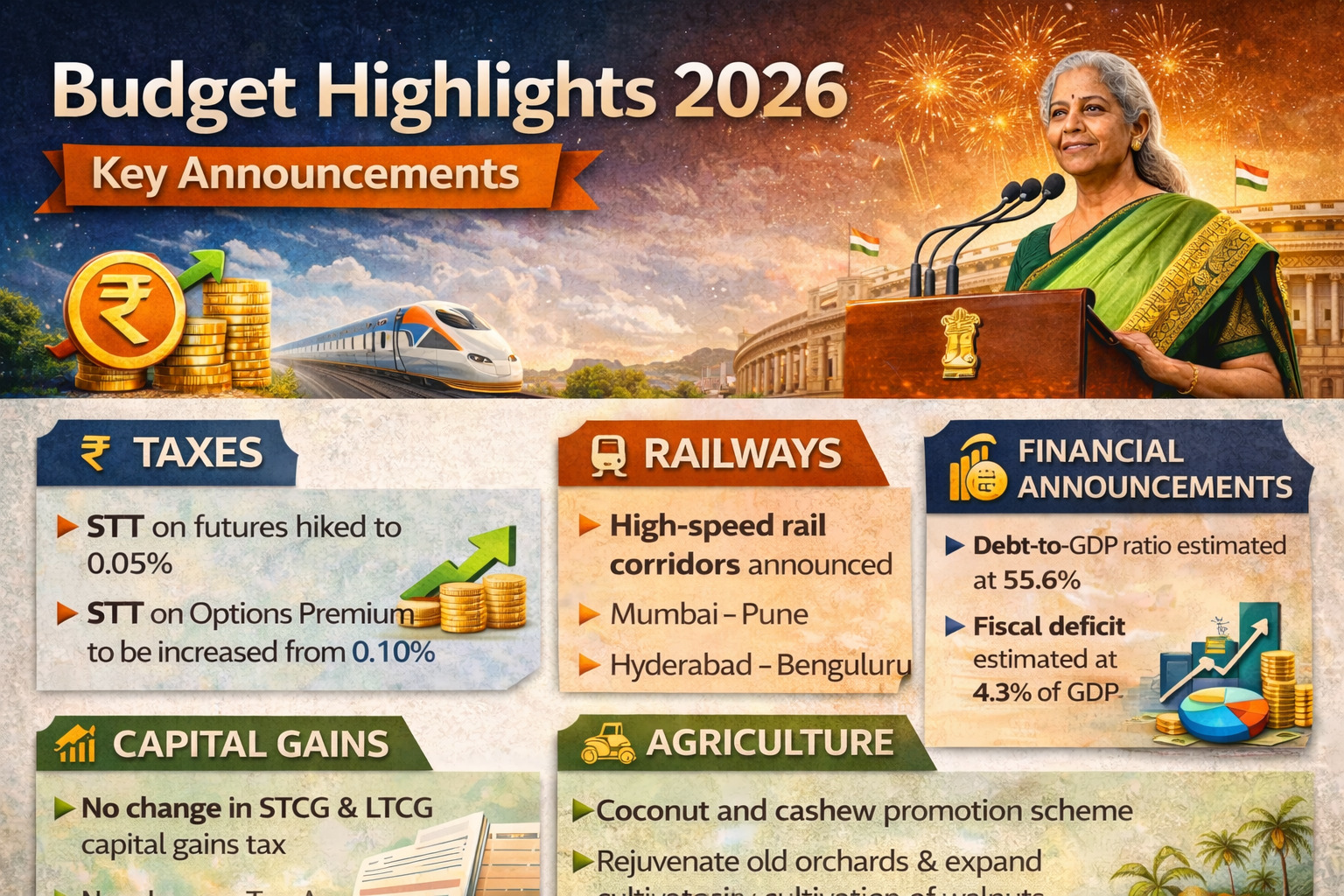
STT
➤ STT on futures hiked to 0.05% from 0.02%
➤ STT on Options Premium to be increased from 0.10% to 0.15%
Capital Gains
➤ No change in STCG & LTCG capital gains tax.
➤ New Income Tax Act to come into effect from April 1, simplified rules and tax return to be notified soon
➤ High-speed rail corridors announced
1. Mumbai-Pune
2. Pune- Hyderabad
3. Hyderabad- Bengaluru
4. Hyderabad-Chennai
5. Chennai-Bengaluru
6. Delhi Varanasi
7. Varanasi -Siliguri
These high-speed rail corridors will link India’s financial hubs, technology centres, manufacturing clusters, and emerging cities with faster and cleaner mobility
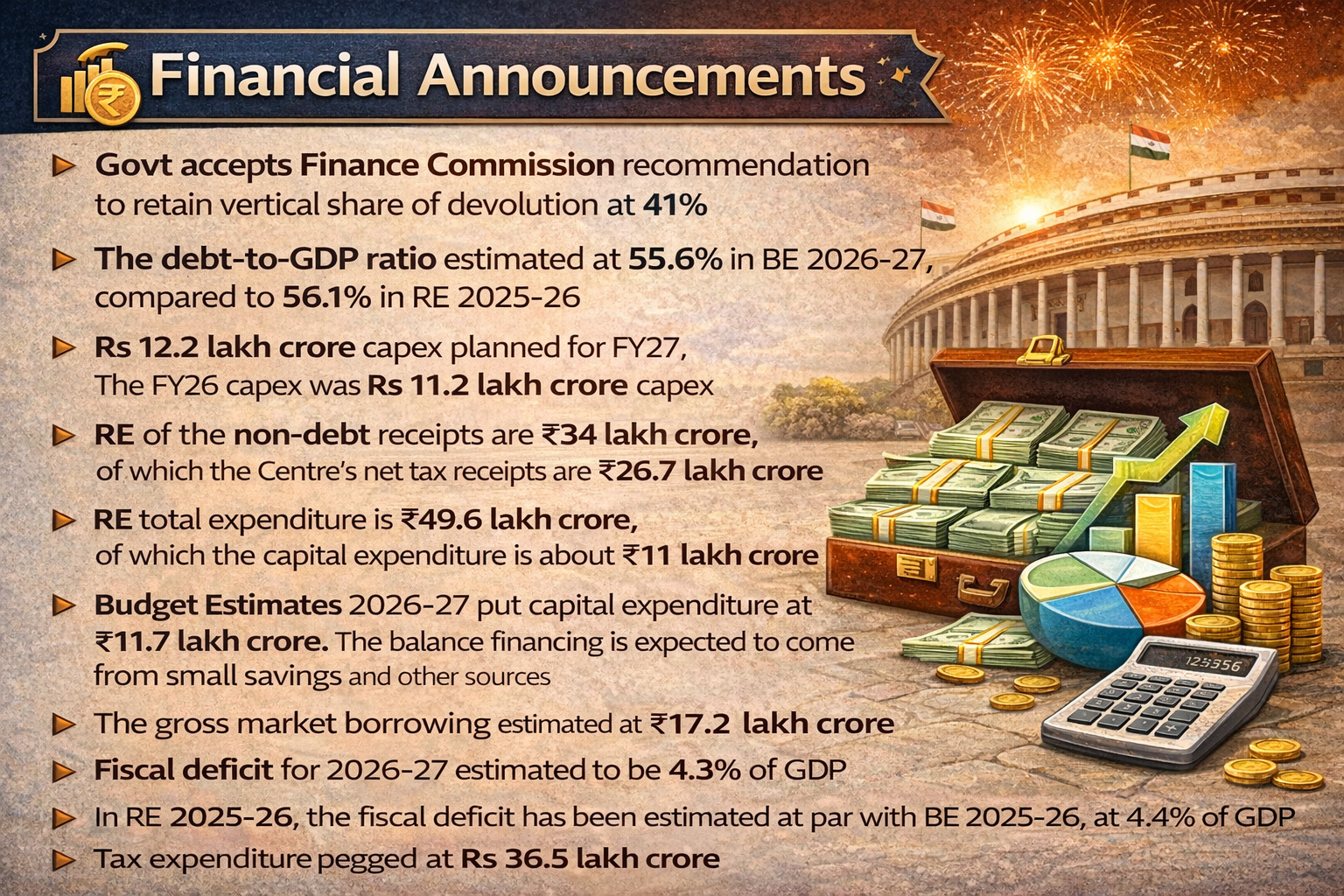
➤ Govt accepts Finance Commission recommendation to retain vertical share of devolution at 41%
➤ The debt-to-GDP ratio estimated at 55.6 percent of GDP in BE 2026-27, compared to 56.1% in RE 2025-26
➤ Rs 12.2 lakh crore capex planned for FY27. The FY26 capex was Rs 11.2 lakh crore capex
➤ RE of the non-debt receipts are ₹34 lakh crore, of which the Centre’s net tax receipts are ₹26.7 lakh crore
➤ RE total expenditure is ₹49.6 lakh crore, of which the capital expenditure is about ₹11 lakh crore
➤ Budget Estimates 2026-27 put capital expenditure at ₹11.7 lakh crore. The balance financing is expected to come from small savings and other sources
➤ The gross market borrowing estimated at ₹17.2 lakh crore
➤ Fiscal deficit for 2026-27 estimated to be 4.3% of GDP
➤ In RE 2025-26, the fiscal deficit has been estimated at par with BE 2025-26, at 4.4% of GDP
➤ Tax expenditure pegged at Rs 36.5 lakh crore
➤ Coconut and cashew promotion scheme announced
➤ Rejuvenate old, low-yielding orchards and expand high-density cultivation of walnuts, almonds and pine nuts.
➤ Support for high-value crops like coconut, cashew, cocoa, agar trees sandal, almonds, and pine nuts to be provided
➤ Fisheries: Integrated development of 500 reservoirs and Amrit Sarovars, Strengthening fisheries
➤ Sandalwood: Focused cultivation and post-harvest processing
➤ Fish caught by an Indian fishing vessel in Exclusive Economic Zone (EEZ) or on the High Seas to be made free of duty. Treating the landing of such fish on foreign port as export of goods.
➤ Fisheries value chain to be enhanced
➤ Exemption from tax dividend income received by a notified national co-operative federation from investments made in companies up to 31.1.2026 from tax for a period of three years. Exemption to be allowed only for dividends distributed to its member co-operatives.
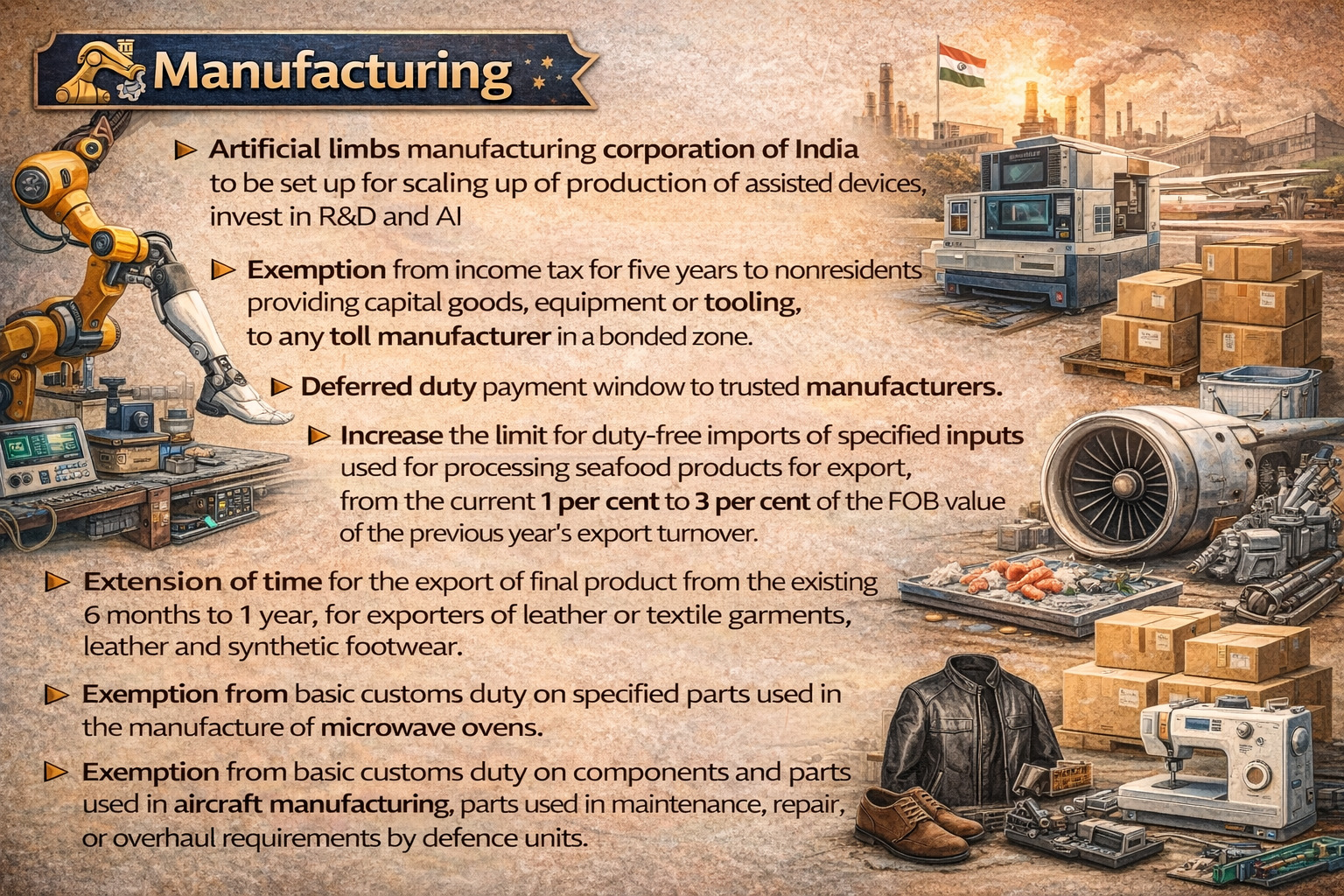
➤ Artificial limbs manufacturing corporation of India to be set up for scaling up of production of assisted devices, invest in R&D and AI
➤ Exemption from income tax for five years to nonresidents providing capital goods, equipment or tooling, to any toll manufacturer in a bonded zone.
➤ Deferred duty payment window to trusted manufacturers.
➤ Increase the limit for duty-free imports of specified inputs used for processing seafood products for export, from the current 1 per cent to 3 per cent of the FOB value of the previous year’s export turnover.
➤ Extension of time for the export of final product from the existing 6 months to 1 year, for exporters of leather or textile garments, leather and synthetic footwear.
➤ Exemption from basic customs duty on specified parts used in the manufacture of microwave ovens.
➤ Exemption from basic customs duty on components and parts used in aircraft manufacturing, parts used in maintenance, repair, or overhaul requirements by defence units.
➤ Khelo India mission to be launched
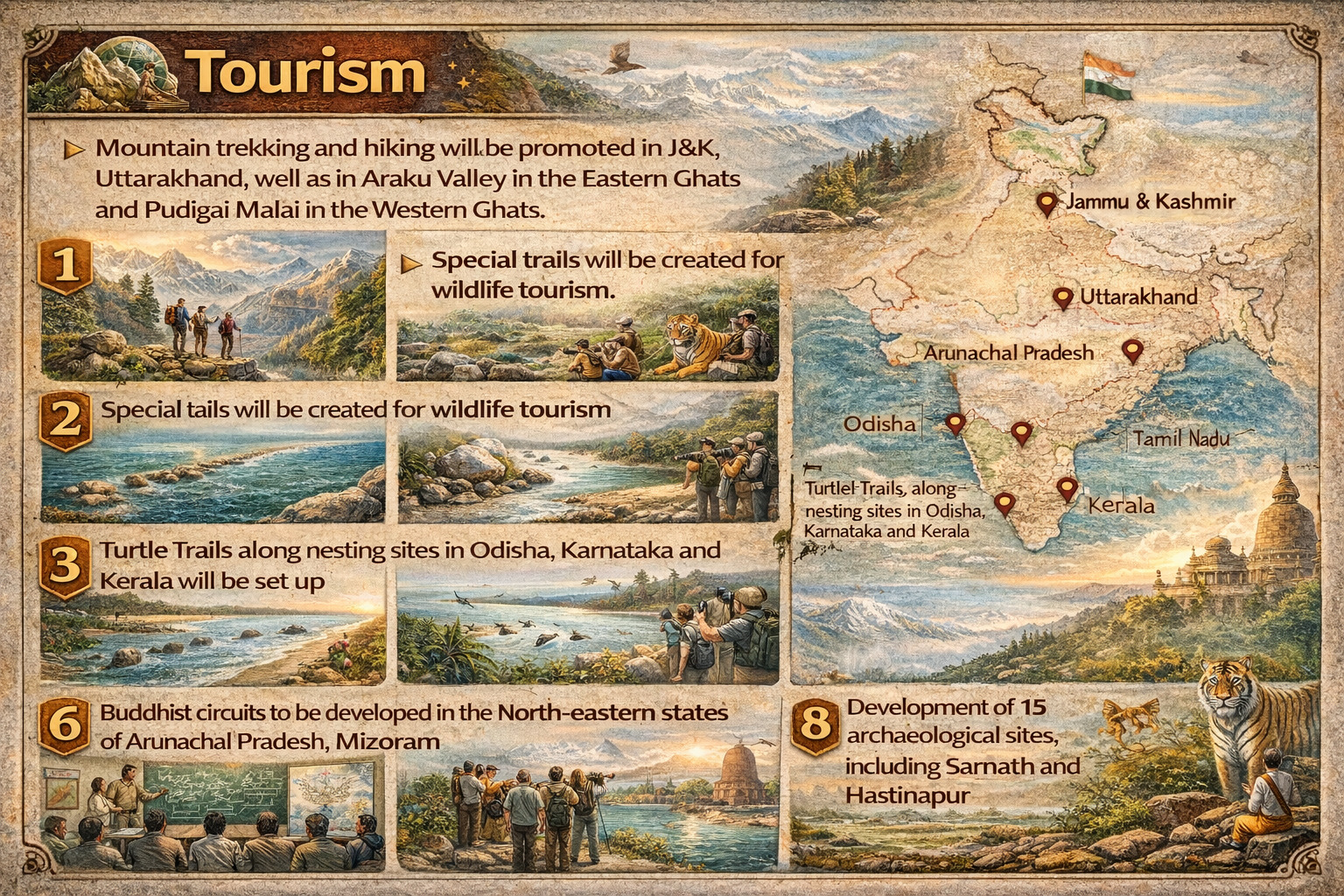
➤ Mountain trekking and hiking will be promoted in J&K, Uttarakhand, well as in Araku Valley in the Eastern Ghats and Pudigai Malai in the Western Ghats.
➤ Special trails will be created for wildlife tourism.
➤ Turtle Trails along nesting sites in Odisha, Karnataka and Kerala will be set up
➤ Bird watching trails to be set up in Andhra and Tamil Nadu around Pulicat Lake
➤ Buddhist circuits to be developed in the North-eastern states of Arunachal Pradesh,
Mizoram
➤ Pilot scheme announced for training tourist guides
➤ India to host the first-ever Global Big Cat Summit.
➤ National Institute of Hospitality to be set up by upgrading the National Council for Hotel Management and Catering Technology. The institute will work closely with academia, industry and government to improve training and standards in hospitality.
➤ A pilot scheme for upskilling announced for 10,000 guides in 20 iconic tourist sites through a standardised, high-quality, 12-week training course in hybrid mode in collaboration with the Indian Institute of Management.
➤ Development of 15 archaeological sites, including Sarnath and Hastinapur
➤ Deadline for filing revised returns extended from December 30 to March 31 with the payment of a nominal fee.
➤ Digital knowledge Grid will be established to document all places of significance, will create new ecosystem of jobs for local researchers, historians and technology partners
➤ Measures to support IT services and attract global investment.
➤ She-Mark for women entrepreneurs to help access to credit linked products
➤ Animal husbandry:
We will support the animal husbandry sector in entrepreneurship development through
a) Credit-linked subsidy program,
b) Scaling up and modernisation of livestock enterprises,
c) Enhanced creation of livestock dairy and poultry focused integrated value chains and
d) Encourage creation of livestock farmer producer organisations.
➤ Five regional medical hubs to be established to promote medical tourism in partnership with the private sector.
a. 1.5 lakh caregivers will be trained
b. Build hubs for medical tourism
➤ Govt to set up NIMHANS 2.0 to bring a mental health institute in North India
➤ Three new All India Institutes of Ayurveda
➤ One girl hostel in every district
➤ Loan-linked capital subsidy support scheme for vet colleges
➤ Setting up AVGC Content Creator Labs in 15,000 secondary schools and 500 colleges.
➤ Five University Townships in the vicinity of major industrial and logistic corridors
➤ A National Destination Digital Knowledge Grid will be created.
➤ India will launch semiconductor mission ISM 2.0 with an outlay of Rs 40,000 for electronics component manufacturing
➤ Rare Earth corridors announced for Kerala, Tamil Nadu and Odisha
➤ A scheme for rare earth permanent magnets was launched in November 2025. We now propose to support the mineral rich states of Odisha, Kerala, Andhra Pradesh and Tamil Nadu to establish dedicated rare earth corridors.
➤ Municipal Bonds: Incentive of Rs 100 crore for single issuance of municipal bonds of more than ₹10,00 crore. The current Scheme under AMRUT will continue.
➤ Restructuring Power Finance Corporation (PFC) and Rural Electrification Corporation (REC).
➤ To enhance last-mile and remote connectivity and promote tourism, incentives will be provided to indigenise manufacturing of seaplanes.
➤ A high-powered Education to Employment and Enterprises (E2E) Standard Committee will be set up
➤ It will recommend steps to strengthen the services sector as a core engine of the economy. The goal is to make India a global leader in services, with a 10% share of the global services market by 2047.
➤ The panel will identify priority areas with the highest potential for growth, employment, and exports. It will also study how new technologies, including artificial intelligence, are changing jobs and skills, and suggest what kind of training and education will be needed.
➤ A tax holiday till 2047 announced to any foreign company that provides cloud services to customers globally by using data centre services from India.
➤ Clubbing of services under a single category of information technology services with a common safe harbour margin of 15.5%.
➤ Safe harbour threshold for IT services is increasing from ₹ 300 crore to ₹2,000 crore.
➤ Approval of safe harbour for IT services by an automated rule-driven process.
➤ Continuation of safe harbour for a period of five years at the company’s choice.
➤ Rs 10,000 crore SME growth fund announced to create future jobs champions.
➤ A three-pronged approach will be followed to help MSMEs grow. Equity support will be provided via MSME growth fund
➤ Self-reliant Indian Fund announced with an outlay of Rs 2,000 crore
➤ Government to facilitate Professional Institutions to develop ‘Corporate Mitras’ especially in Tier-II and Tier III towns, to help MSMEs meet compliance requirements at affordable costs.
➤ Removal of the current value cap of ₹10 lakh per consignment on courier exports.
➤ Scheme for small taxpayers announced
➤ Recycling of real estate assets of the CPSEs through setting up of dedicated rights.
➤ Setting up Infrastructure Risk Guarantee Fund to provide prudently calibrated partial credit guarantees to lenders.
➤ New freight corridor announced for Dankuni in West Bengal
➤ 20 new waterways to be operationalised, starting with one in Odisha
➤ Setting up a ship repair ecosystem catering to inland waterways.
➤ Infrastructure risk guarantee fund with credit guarantee for lenders
➤ Launch a Coastal Cargo Promotion Scheme to increase the share of inland waterways and coastal shipping from 6% to 12% by 2047.
➤ Launching a Seaplane VGF Scheme to indigenise manufacturing.
➤ ₹2 lakh crore support to states under SASCI Scheme.
➤ Purvodaya: Development of Integrated East Coast Industrial Corridor.
➤ Mega textile parks to be set in challenge mode
➤ Textile labour incentive scheme and national handloom and handicrafts programme announced in Budget
➤ Khadi and handicrafts textiles to be strengthened
➤ Mahatma Gandhi Gram Swaraj scheme to be launched
➤ Rejuvenation of 200 legacy industrial clusters
➤ Bio-pharma shakti proposed with an outlay of Rs 10,000 crore: Under the scheme biopharma-focused network will be established with three new institutes.
➤ Scheme to enhance manufacturing and construction
➤ FM Sitharaman proposes interventions in six areas:
1. Scaling up manufacturing in several strategic and frontier sectors.
2. Rejuvenating legacy industrial sectors.
3. Creating champion MSMEs.
4. Delivering a powerful push for infrastructure.
5.Ensuring long-term security and stability.
6. Developing city economic regions.
1. Accelerate economic growth and sustain economic growth by enhancing productivity and competitiveness and building resilience
2. Fulfil aspirations of our people and build their capacity, making them strong partners in India's path to prosperity.
3. Aligned with the vision of sabka saath, sabka vikaas, every family, community, region, and sector has resources, and opportunities for meaningful livelihood
➤ Keeping Atmanirbharta as a lodestar, we have built domestic manufacturing capacity, energy security and reduced critical import dependencies. Simultaneously, we have ensured that citizens benefit from every action of the government, undertaking reforms to support employment generation, agricultural productivity, household purchasing power and universal services to people. These measures have delivered a high growth rate of around 7% and helped us make substantial strides in poverty reduction and improvement in the lives of our people.
➤ Today, we face an external environment in which trade and multilateralism are imperiled. And access to resources and supply chains are disrupted. New technologies are transforming production systems while sharply increasing demand on water, energy and critical minerals. India will continue to take confident steps towards Vikasit Bharat by balancing ambition with inclusion.
➤ Today, we face an uncertain global environment, says Finance Minister Nirmala Sitharaman while starting her speech.
➤ FM Sitharaman says she is announcing the budget on the auspicious day of Magha Purnima and Ravidas Jayanti
➤ Since we assumed office 12 years ago, India’s economic trajectory has been marked by stability, fiscal discipline, sustained growth and moderate inflation.
Ans. Union Budget 2026 is the annual budget of the Indian government that shows financial plan and priorities in relation to revenue, spending and economy.
Ans. Budget Highlights 2026- It involves tax reform, infrastructure expansion, supporting MSMEs, agricultural development, healthcare, education, and semiconductor manufacturing.
Ans. The budget helps farmers with the modern farming techniques, irrigation schemes, agri-technology, livestock keeping, and improved insurance plan.
Ans. MSMEs get easy loans, tax subsidies, skill training, and tax incentives to increase manufacturing and export.
Ans. Semiconductor manufacturing will boost importation, enhance the supply chains in technology, and enable India to counter global competition, including that of China.
The property, complete with 30-seat screening from room, a 100-seat amphitheater and a swimming pond with sandy shower…
The property, complete with 30-seat screening from room, a 100-seat amphitheater and a swimming pond with sandy shower…
The property, complete with 30-seat screening from room, a 100-seat amphitheater and a swimming pond with sandy shower…

The property, complete with 30-seat screening from room, a 100-seat amphitheater and a swimming pond with sandy shower…
The property, complete with 30-seat screening from room, a 100-seat amphitheater and a swimming pond with sandy shower…
The property, complete with 30-seat screening from room, a 100-seat amphitheater and a swimming pond with sandy shower…