Inside UGC’s 2026 Anti-Discrimination Framework | Reform, Reach, and Risks
A detailed analysis of UGC’s 2026 Anti-Discrimination Framework, exploring reforms, enforcement mechanisms, protected groups, institutional risks, and campus-level impact.



San Francisco
A detailed analysis of UGC’s 2026 Anti-Discrimination Framework, exploring reforms, enforcement mechanisms, protected groups, institutional risks, and campus-level impact.

The University Grants Commission (UGC) announced the Promotion of Equity in Higher Education Institutions Regulations, 2026 in January 2026, which provides a legally binding scheme to target discrimination in Indian campuses. The new rules which have replaced the previous 2012 regulations are a breakthrough since they no longer serve as advisory substances but a binding obligation which puts direct responsibility on universities and colleges and their administrations.
Simply put, the framework aims at making sure that each and every student, teacher, or member of the staff is not denied the dignity or chance in higher education due to identity. Although the motive has been generally claimed to be progressive and long overdue, the scope of the regulations, its implementation strategies, and the lack of some procedural protection have raised a heated debate within the academic circles.
Once institutions start realising these regulations, the bigger question remains, will the 2026 regulations make campuses more inclusive and trusting, or will they create additional fault lines in Indian higher education?
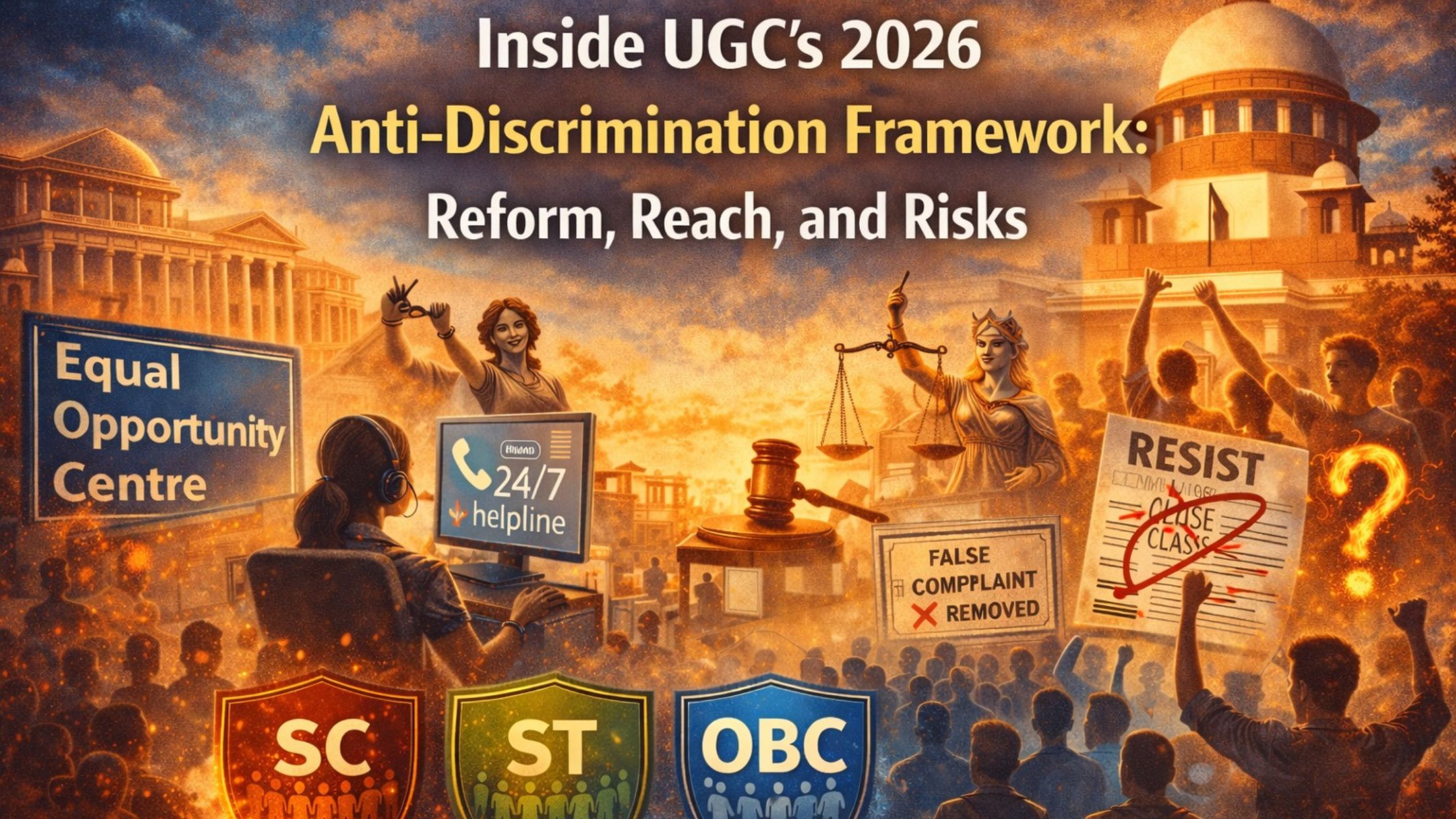
The biggest modification that the 2026 regulations brought is their binding character as per the law. In contrast to the 2012 framework, which was more of a guideline on what should be done, the new rules are obligatory to all Higher Education Institutions (HEIs), including the public and the private.
The leaders of institutions are no longer mere administrators, that is, heads of institutions, Vice-Chancellors, Principals, and Directors. Now they are the front force in the prevention, identification and responding to discrimination. Non-compliance may be met with harsh measures such as being barred out of UGC schemes, denied permission to run new programmes and even deprived institutional recognition.
This change appropriates the standpoint of the UGC that discrimination in campuses is not a social problem but a failure of governance that needs institutional accountability and regulation.
The rules openly give precedence in protections of historically disadvantaged groups, which follows the remedial approach in line with the constitutional principle of substantive equality.
The secured categories are:
It is important to note here that formal inclusion of OBCs in the anti-discrimination model is a massive expansion of previous drafts and structures and ensure a historical omission has been addressed. Although the protections are applicable to all students, teachers, and staff members, the prioritisation is an indicator of a recognition of long-standing social hierarchies that persist in the access and experience of higher education.
The definition of discrimination itself is one of the most controversial ideas of the 2026 framework.
The regulations have a wide and far-reaching definition that includes beyond the actual and explicit acts of discrimination, the indirect, subtle, and structural forms of unwarranted treatment. Even the acts that do not involve any over discrimination can be encompassed in the criteria as long as they lead to the impairment of equality or violation of human dignity.
This method will enable institutions to deal with implicit exclusion and micro-aggressions, along with systemic prejudice that can be overlooked by conventional disciplinary processes. Critics posit, however, that the concepts of structural unfairness and impairment of dignity are not qualified enough and wide discretion has been left to institutional committees.
It is not just a matter of belief. Without clear thresholds of proving or elaborated assessment standards, similar cases in one institution can be dealt with differently and thereby the results are not even and dependability is also not known by the complainant or even the respondent.
In order to make the framework operational, each HEI must create a series of new bodies and mechanisms:
Every institution should establish the Equal Opportunity Centre where policy should be implemented, awareness should be built, counselling needs to take place, outreach, and grievances should be addressed. Smaller colleges can use the EOC of their university of affiliation, so that similar applicability is applied throughout the sector.
Each EOC should possess an Equity Committee that is led by the institutional leader. The composition of the committee is prescribed to be composed of:
Women, SCs, STs, OBCs, and people with disabilities must be represented, which speaks of the inclusive nature of the framework.
In addition to institutionalized committees, the rules establish Equity Squads to patrol “vulnerable areas” like hostels, laboratories and common rooms. The Equity Ambassadors serve as nodal points of reporting within the departments and facilities.
Although meant to act as preventive measures, these measures have brought issues of over-surveillance and the chilling effect of the informal academic and social interactions.
Speed and responsiveness is highly emphasized in the regulations.
It should have a 24/7 equity helpline which is compulsory and where disclosure of a prima facie offence under penal law, the information should be sent to law enforcement agencies.
According to the supporters, these timelines are necessary in avoidance of institutional delay and victim fatigue. Opponents, though, doubt the possibility of hearing such complicated claims--particularly of academic decision-making or administration in such limited periods.
The observation of the regulations is done by direct governance by the UGC. Inspections, information requests, and review committees on the national level are all monitoring mechanisms.
Non-compliance can result in:
These punishments emphasize the severity with which the UGC regards equity compliance as something that makes it an institutional legitimacy issue and not a voluntary obligation.
Though they have their reasons, the regulations have continued to encounter opposition and especially in the case of general category student groups and faculty associations.
Key concerns include:
Critics also believe that the framework is sound on protection, but weak on procedural balance. The protocols of confidentiality of respondents during interim are not clearly stated, counselling services in presence of inquiries, and post-inquiry measures to restore the damaged reputation of the defamed persons are absent.
Other student organisations have doubted that the regulations may infringe Article 14 of the Constitution that states equality before the law.
Under the law, it is acceptable to treat people differently, as long as it has a legitimate remedial goal and the process used is non-arbitrary. The rules are placed in a corrective and not an exclusionary context. Nevertheless, this is not so much to do with the text but with the possible level of inequity in application between institutions.
The concern here is that with open-handed application, coupled with ambiguous definitions and the lack of protective measures, it might have an unbalanced result in practice, despite the intention of the law being constitutionally sound.
The general consensus among experts on the matter is that structural mechanisms are not sufficient to eliminate discrimination. Although the 2026 rules impose new agencies and processes, their effectiveness will eventually rely on the institutional culture.
Calls have been made for:
And in case of lack of such measures, a danger exists that compliance will be more symbolic than transformative.
The 2026 anti-discrimination guidelines can be seen as one of the most ambitious regulation intercessions in Indian higher education in the last few years. It institutionalizes responsibility, increases safeguards and indicates a solid institutionalization of a dedication to equity.
Meanwhile, its long term effect will be based on its fair, transparent and consistent implementation. Striking a balance between protecting the victims and protecting the accused will be important in establishing trust instead of creating further division.
With several legal issues, institutional changes, and campus deliberations ongoing, the next few months will tell whether the rules will manage to establish safer, more inclusive institutions of higher learning- or whether any additional adjustments will be necessary to meet their claimed purposes.
Ans- The UGC Promotion of Equity in Higher Education Institutions Regulations, 2026 are legally enforceable guidelines in which all the universities and colleges in India are expected to prevent, detect, and deal with discrimination within the university. They contain a replacement of the previous 2012 advisory framework by imposing compliance mechanisms.
Ans- The laws are applicable to students, teachers, and all the personnel in higher learning institutions. They are focused on the protection of Scheduled Castes (SCs), Scheduled Tribes (STs), Other Backward Classes (OBCs), Economically Weaker Sections (EWS), and the persons with disabilities and are relevant to all stakeholders.
Ans- To ensure discrimination is addressed and avoided, every higher education institution needs to establish an Equal Opportunity Centre (EOC), Equity Committee, 24/7 equity helpline and monitoring bodies like Equity Squads and Equity Ambassadors.
Ans- There have been critics that the definition of discrimination is overly broad, there are no safeguards against malicious or false complaints, and that it could affect academic freedom. Questions also exist on whether bias or procedural unfairness may be caused by uneven implementation.
Ans- Failure to comply may result in severe sanctions of the UGC, such as debarment of funding schemes, prohibition of new programmes, and exclusion of the organisation in UGC-approved lists of institutions, and therefore compliance is very essential in terms of institutional legitimacy.
The property, complete with 30-seat screening from room, a 100-seat amphitheater and a swimming pond with sandy shower…
The property, complete with 30-seat screening from room, a 100-seat amphitheater and a swimming pond with sandy shower…
The property, complete with 30-seat screening from room, a 100-seat amphitheater and a swimming pond with sandy shower…


The property, complete with 30-seat screening from room, a 100-seat amphitheater and a swimming pond with sandy shower…

The property, complete with 30-seat screening from room, a 100-seat amphitheater and a swimming pond with sandy shower…

The property, complete with 30-seat screening from room, a 100-seat amphitheater and a swimming pond with sandy shower…