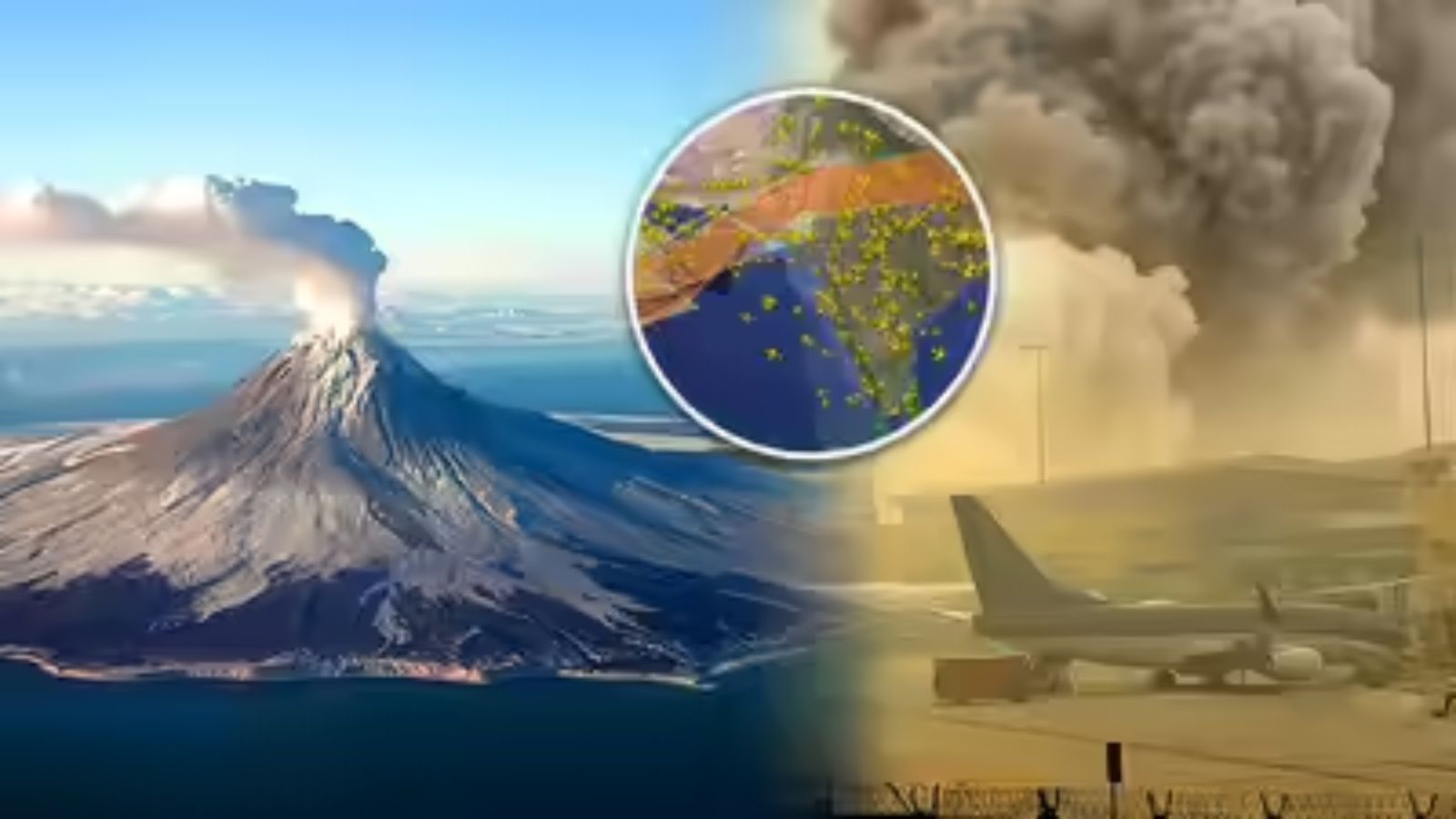
Ethiopia Volcano Eruption: Full Highlights with All Updated Details
An immense volcanic eruption in Ethiopia has made a series of events have an international impact. On 23 November 2025, an eruption of the shield volcano Hayli Gubbi occurred following approximately 10,000-12,000 years of inactivity
Somya
December 06, 2025
Updated 09:54 pm
A huge jet of ash shot into the atmosphere. That ash cloud has followed the seas and continents, even reaching sections of North-West India, such as Delhi and regions around it.
These are all you need to know - details of the eruption, after-effects in India, and the latest word by the experts.
What Happened in Ethiopia
The Hayli Gubbi volcano, which was in the Afar region of Ethiopia, went off on 23 November 2025.
The ash column rose to 14km (approximately 45,000 ft) in the air with rock dust, sulfur dioxide and fine volcanic dust.
This is a historic eruption: the first in millennia recorded eruption of Hayli Gubbi since it became extinct.
At the local level, Ethiopia in the Afar area, the citizens and pastoral communities were directly affected as there has been immediate disruption, given that heavy ash fall has affected the grazing territory, the air quality, and visibility in the region. It may jeopardize livestock and livelihood.
How the Ash Cloud Reached India & Its Path
The strong eruption completed the volcanic ash and the volcanic gas in high altitudes in the atmosphere. Intense upper winds made the ash cloud drift along the Red Sea, the Arabian Peninsula, and eastwards to India.
By Monday evening (24 November), the plume had moved to the Indian airspace through western Rajasthan. It moved at a high speed of about 100-130 km/h, covering Gujarat, Rajasthan, Punjab, Haryana, Delhi- NCR and the surrounding areas around 10-11 pm.
The aviation and meteorological agencies such as the India Meteorological Department (IMD) and Directorate General of Civil Aviation (DGCA) monitored the movement of the plume keenly and warned the airlines.
Impact on Flights & Travel Disruptions
Due to the fact that volcanic ash is very dangerous to the aircraft, since it damages engines, blocks air filters as well as poses a navigational threat; several flights had to be cancelled or diverted.
Some Indian airlines such as Air India and Akasa Air are canceling and undergoing safety inspections.
Some of the first flights that were affected were domestic and international flights that linked India and the Middle East and Europe.
DGCA released the safety alert: it was advised that the airlines should not fly in the airspace that is polluted with ash, to make changes in routes, and pay attention to engine functioning.
By Tuesday evening, the officials said that the majority of the ash plume had ceased to be located in India and flight operations were starting to be normal again in most locations.
Did Volcanic Ash Impact Air Quality or Weather in Delhi & North India?
This was among the largest questions in the minds of people- particularly because there are already areas in North India that are facing the issue of poor air quality during winter periods.
IMD and experts state that the ash cloud was mostly in the upper troposphere (high altitude) - not mixed with air at the surface.
Consequently, the impact on the air conditions and weather at the ground was not significant. There could have been some slight haze or strange colour of the sky, but there were no serious health or pollution effects.
According to the officials, the visibility could decrease at the cost of a few minutes, and sunsets or sunrises could appear peculiar temporarily, but the ash cloud would not lead to a significant increase in pollution levels.
In short: in the opinion of most urban residents, the eruption caused greater disturbance in the air travel than daily pollution or weather modification.
Health & Safety Advice From Experts
The volcanic ash may be hazardous, particularly when being drawn directly, however, at ground level there existed the possibility of minor risk. Nevertheless, the precautionary advice was given by experts and health agencies:
Do not go outside in the air, try to stay indoors when ash comes by.
Individuals with respiratory illnesses (asthma, bronchitis) are advised to restrict their outdoor exercise and wear masks in case of necessity.
Protective masks and eye protection should be used by anybody cleaning dust or ash residues.
The authorities came up with an additional request asking travellers to verify flight status frequently and airlines to adhere milkingly to ash-cloud warnings.
What’s the Current Situation as of Now?
The eruption ash cloud that was launched by Ethiopia has moved to a great extent out of Indian airspace.
Airlines are on guard to changes but gradual changes are observed in the flight operations returning to normal.
The weather conditions and surface air quality are also not much affected, though there is always a problem of winter smog and regular cycles of pollution.
Surveillance is also on-going particularly along avenues of travel and high traffic areas in the air.
FAQs
Q-1. Which volcano erupted in Ethiopia and when? Ans- The volcano is Hayli Gubbi which is found in the Afar region of Ethiopia. It broke out on 23 November 2025, some 10,000-12,000 years after it had lapsed.
Q-2. Did the volcanic ash reach India? Ans- Yes. This ash plume flew across the Red Sea and landed on Indian airspace, reaching some of western and northern Indian including Delhi-NCR, 24-25 November.
Q-3. Were flights disrupted in India due to the ash cloud? Ans- Yes. Many flights (in particular international flights) were cancelled or diverted. Airline companies such as Air India and Akasa Air checked baggage at the ground level and modified flight schedules based on the safety recommendations.
Q-4. Does volcanic ash affect air quality and weather on the ground? Ans- In this case, scientists believe that the ash remained on a high elevation and had a low impact on the quality of air and weather on the surface of Delhi and North India.
Q-5. Is the risk over now, or should we still stay alert? Ans- The bearing of most of the ash cloud is over, and flights are returning to normal. Nevertheless, aviation authorities and meteorological organisations are able to observe the movement of ash - particularly along air routes and mountainous areas.